
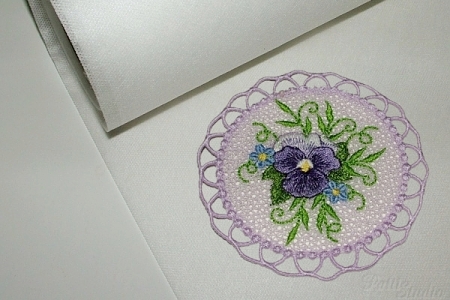
As there are quite a few lace designs among my collections and beginers sometimes struggle to achieve perfect results, I’ve put together a short informational tutorial on how I embroider my laces on water-soluble stabilizer.
Understanding Water-Soluble Stabilizers
Water-soluble stabilizers come in a variety of types and weights. The right choice depends on your intended use. All of them are made from 100% polyvinyl alcohol, which completely dissolves in liquid — the warmer the liquid, the faster the process.
We usually use water to dissolve the stabilizer, but remember: any liquid will work. That means proper storage and handling are essential — a single drop, a stray splash, or even high humidity from a foggy window can start breaking it down.
Here in the Czech Republic, the selection isn’t as wide as abroad, so I mainly work with two types: non-woven vlieseline and film/foil.
Film: My First Choice in the Early Days
When I first started, film was the only option available — and only in one weight. I used it mostly for free-standing lace designs. Because it was so lightweight, I often had to use two or three layers to prevent tearing (both film and thread). Today, heavier-weight films are available, which is a huge improvement.
Film can be smooth or slightly textured. Over time, especially with smooth film, it may become cloudy or slightly milky in appearance, but this doesn’t affect performance. It may also stiffen a bit, which you can fix by gently pressing it through a cloth with a warm iron. Creases from storage are also harmless — once it’s hooped tightly, they won’t show in the embroidery.
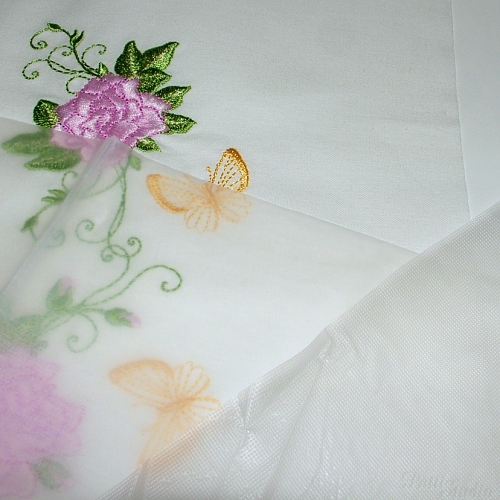
Discovering Nonwoven Fleece (Vilene)
Later, on international embroidery forums, I learned about a non-woven vlieseline sold under the name Vilene. After some searching, I found an importer for the Czech market. While Vilene is more expensive than film, you only need one layer for lace, and it doesn’t tear. In the end, it works out to about the same cost. You might also find it under the names Soluvlies or Soluweb.

How to Embroider Lace on Water-Soluble Stabilizer
Hooping the Stabilizer
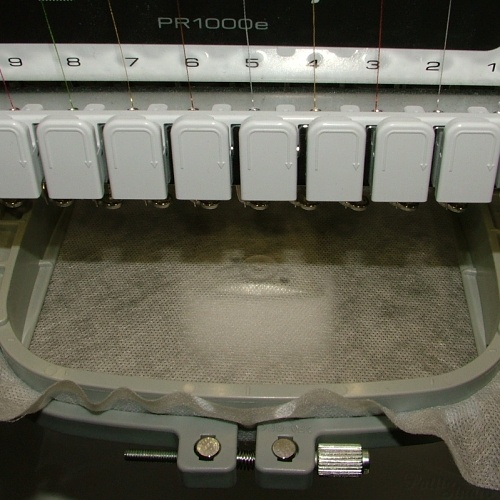
Cut the needed size and hoop it tightly. Tighten your hoop more than you would for regular fabric, as a single layer of stabilizer is much thinner. It should be drum-tight — firm when tapped, with no sagging. Loose hooping can lead to puckering, misaligned outlines, and frequent thread breaks.
Adjusting Speed and Using Quality Thread
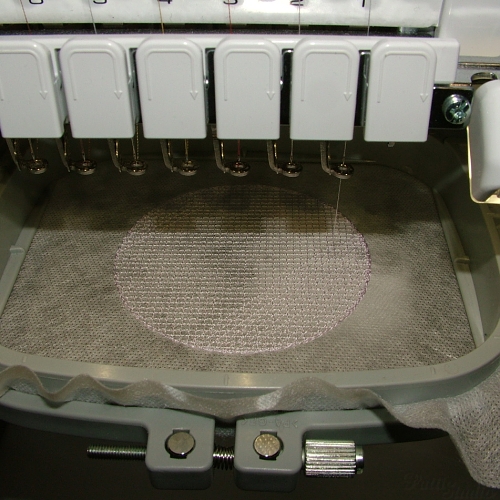
Slowing down your machine can help, though industrial models can handle 1000 stitches per minute for lace. Still, a slightly slower pace often means fewer thread breaks. Always use high-quality thread — what might be “good enough” for fabric won’t be suitable for lace. I love the sheen of rayon (viscose) thread, but polyester generally tolerates higher speeds.
Check the Needle
Surprisingly, needle sharpness makes a big difference with lace. A dull needle can cause far more breakage.

Thread Choices for the Bobbin
Some embroiderers use the same thread in the bobbin and on top, creating lace that’s equally attractive on both sides and slightly stiffer. I only do this when the back will be visible — otherwise, I stick with regular bobbin thread. Winding multiple colors of top thread onto bobbins can be tedious, especially for multicolored designs.

Dissolving the Stabilizer
Once finished, remove the lace from the hoop and trim away the excess. Soak it in warm water until the stabilizer dissolves — the warmer the water, the faster it goes. For best results, let it sit in a bowl of water rather than rubbing it under running water.
For decorative lace that needs to hold its shape, soak only briefly so that a little stabilizer residue remains in the threads — this will stiffen the lace once it dries. If you accidentally wash away too much, you can stiffen it afterward with starch or even sugar water (a tried-and-true method from our grandmothers for crochet work). Lay the lace flat to dry on a towel, then press it once dry.
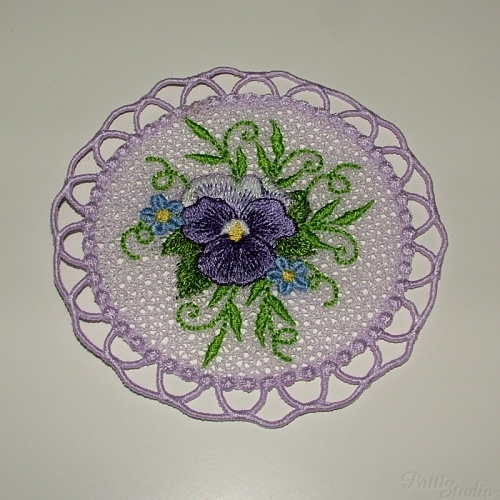
Choosing the Right Lace Design
When buying lace patterns, make sure you’re getting true lace — also known as free-standing lace (FSL). These designs are digitized so that stitches are interlocked and hold together even after the stabilizer is removed. If you stitch a regular lace-fill design on water-soluble stabilizer, it will completely fall apart after washing.
Hope these tips of mine are helpful for your and till the next time Happy Embroidering  .
.
Resources:
- Pink flowers with butterflies design: part of the Gardenias set
- Pansy lace medallion: part of the Lace Medallions set
You must be logged in to post a comment.